Email sequence

The pre-call sequence

01Day one

Hours 0 to 24 after booking · 5 emails

  1. 01 Confirmation Hour 0right after they book Show-up
    Andrew Koutnikteam@andrewkoutnik.com

    Your call with my team is booked

    PreviewThree things to have handy, and what the call actually is.

    Hey {FIRST NAME},

    You're booked. Your call with my team is on [CALL TIME].

    Add it to your calendar now so nothing moves it: [CALENDAR LINK]

    Here's what the call is.

    It's a conversation with someone on my team about your type 1: where your numbers are now, what keeps knocking them off, and whether Steady State is the right way to fix that.

    It isn't a lecture and it isn't a hard sell. If it's not right for you, they'll tell you.

    To make it useful, have three things handy.

    Your last 14 days of CGM data. A screenshot from your Dexcom or Libre app is fine.

    Roughly how much insulin you take in a day, basal and bolus.

    The one thing you'd most like to change. The night lows, the post-dinner climb, the workout crash, or something else entirely.

    Take the call somewhere quiet, on a laptop if you can, so you can look at your graph together.

    Over the next few days I'll send you everything I'd want to know before a call like this, so you walk in with your questions already answered.

    Andrew
  2. 02 Why Steady State exists +1 hourafter booking Why they'd buy
    Andrew Koutnikteam@andrewkoutnik.com

    The contact form on my website

    PreviewWhy I built Steady State, and why it's my team you'll talk to.

    Hey {FIRST NAME},

    While you wait for your call, I want you to know why Steady State exists, and why it's my team you'll be talking to.

    I was 16 when I ended up in a hospital bed and heard three words that changed my life: type 1 diabetes.

    I got the standard plan. Count carbs, take insulin, and hope the numbers balance out. I followed it, and it didn't work for me.

    More than ten years ago I changed the way I eat. Almost immediately my numbers settled, and I needed 43% less insulin. My HbA1c has stayed around 5.5% ever since.

    Then I spent my career working out why. Over 100 peer-reviewed papers and abstracts, the first international guidelines on carbohydrate reduction in type 1, and my own case in the scientific literature.

    Until now, the only way to work with me on this was a contact form on my website, one person at a time.

    And under my TEDx talk, people who'd lived with type 1 for 30 and 40 years were writing that nobody had ever told them food mattered.

    Helping people one at a time was never going to reach them.

    So I built Steady State. I teach the weekly call myself. A certified diabetes educator coaches you between calls and looks at your data every week. And my team handles the parts that need more hands than I have, starting with your call and the Steady State Plan they'll build from your CGM data.

    That's who you'll be talking to. They know this method, and the whole call is about your numbers.

    Your call is on [CALL TIME]. If anything changes, you can move it here: [CALENDAR LINK]

    Andrew

  3. 03 The reframe +3 hoursafter booking Why they'd buy
    Andrew Koutnikteam@andrewkoutnik.com

    It was never your discipline

    PreviewWhy my team looks at your graph before anything else.

    Hey {FIRST NAME},

    Before your call, I want you to hear this from me.

    If your numbers have been all over the place for years, it was never your discipline. It wasn't your pump settings, and it wasn't your endo either.

    It was the size of the inputs.

    Big carb loads need big doses. Every big dose carries a big error, because carb counts are estimates and insulin never acts exactly the same way twice, and no pump can fully catch that.

    Lower the load and the doses shrink, the errors shrink with them, and the line on your CGM flattens out.

    Smaller inputs, smaller mistakes. That's the Low-Load Method.

    It's also why your call starts with your CGM data. My team isn't looking for what you did wrong. They're looking for where your biggest inputs are, because that's where your biggest swings come from.

    Sometimes it's one meal. Sometimes it's the stretch between dinner and bed. Your graph usually makes it obvious.

    Andrew

    P.S. My own last 30 days read 98% time in range. My doses still aren't perfect. The misses are just small.

  4. 04 What you've already tried +6 hoursafter booking Why they'd buy
    Andrew Koutnikteam@andrewkoutnik.com

    Tighter counting, more corrections, a better pump

    PreviewWhy none of them flattened the line for good.

    Hey {FIRST NAME},

    If you're like a lot of people with type 1, you've already tried a few things before booking this call.

    Counting carbs more carefully. Weighing food, reading every label, logging every gram. It helps a bit, but a carb count is still an estimate, and a careful estimate of a big number is still a big guess.

    Correcting more often. Chasing every high with another dose. It brings the number down, then often brings it down too far, and now you're treating a low at 2 AM.

    A better pump. Automated pumps are a real step forward. But the algorithm reacts to a rise that's already started. A big plate of fast carbs is like a small hose turned all the way on, and no algorithm can fully catch that.

    Low carb on your own. That one gets you halfway. Then the late climbs after dinner make you think it doesn't work for you. (I'll come back to that one.)

    Every one of those works on the dose, and none of them changes the size of what you're dosing for.

    Change that, and everything else you've tried starts working better. Smaller inputs mean smaller doses, smaller doses mean smaller misses, and suddenly your counting is more accurate, your corrections are smaller and your pump looks a lot smarter.

    It's why Steady State starts with your plate in weeks 1 to 4, before anything else.

    When you talk to my team, tell them what you've already tried. It tells them a lot about where your biggest inputs are.

    Andrew

  5. 05 The 12 weeks +10 hoursafter booking Why they'd buy
    Andrew Koutnikteam@andrewkoutnik.com

    What the 12 weeks actually look like

    PreviewIncluding the plan my team builds from your own CGM data.

    Hey {FIRST NAME},

    My team will walk you through Steady State properly on the call, but I don't want any of it to be a surprise. So here's the whole picture.

    It's 12 weeks in three phases, one for each piece of the masterclass.

    Weeks 1 to 4, the Low-Load plate. You rebuild your meals so they need far less insulin.

    Weeks 5 to 8, dosing for real food. You learn to dose for protein and fat, alongside your care team, so the late climbs stop.

    Weeks 9 to 12, training without the crash. The pre-workout protocol, your overnight plan, and how to handle sick days, travel and eating out.

    Short lessons, one action a week. Nothing that needs a free afternoon.

    Every week I run a 90-minute live call. I teach one thing, then pull up members' CGM graphs and go through them live. If you can't make it, it's recorded.

    You also get your own coach, a certified diabetes educator, who reviews your CGM data every week and answers questions in between. You won't be stuck guessing on a Thursday night until the next call.

    Then there's the part I'm proudest of.

    From your first 14 days of CGM data, my team builds your Steady State Plan for you. It's built from your numbers, not pulled from a template, and it includes three things.

    Your starting meal map, so you know what to eat from week one.

    A dosing worksheet to take to your care team.

    A one-page Endo Brief with the research behind it, so the conversation with your endocrinologist starts on the right foot.

    On top of that you get the Low-Load Meal Library, the Sick-Day and Travel Playbook, and the private Steady State community with the full call vault.

    Write down anything you want to ask about it. That's exactly what the call is for.

    Andrew

02Day two

Hours 24 to 48 · 4 emails

  1. 06 "I've tried low carb" +22 hoursafter booking Why they wouldn't buy
    Andrew Koutnikteam@andrewkoutnik.com

    "I've already tried low carb"

    PreviewYou probably did the hard part well. One piece was missing.

    Hey {FIRST NAME},

    There's one thing people with type 1 tell me more than anything else.

    "I've already tried low carb. It didn't work for me."

    I believe you, and I'd bet you did the hard part well.

    You cut the bread, the pasta and the cereal. Your mealtime doses dropped, and the first couple of hours after a meal looked better than they had in years.

    Then, about three hours after dinner, the line started to climb. A slow, stubborn climb that a correction never quite caught, and some nights it ran all the way to morning.

    So you decided low carb didn't suit your body. Anyone would have.

    What actually happened is that you cut the carbs and kept dosing like a carb counter.

    Protein and fat raise blood sugar too, just later and slower. Dose a steak dinner like a slice of toast and your insulin has finished working by the time the protein and fat arrive.

    It wasn't the diet. It was the timing.

    That's weeks 5 to 8 of Steady State, dosing for real food. It's also where your coach earns their keep, because the right timing is different for everyone. You find yours by looking at your own CGM data every week, with your care team in the loop.

    So if part of you is worried this is the same thing that already let you down, say so on the call. Tell my team what happened, and they'll show you where the missing piece was.

    Andrew

  2. 07 The numbers +28 hoursafter booking Why they already buy
    Andrew Koutnikteam@andrewkoutnik.com

    The numbers I'd want to see before a call like this

    PreviewMy own CGM report, and what viewers wrote under my TEDx talk.

    Hey {FIRST NAME},

    If I were about to get on a call about a program like this, I'd want to see some numbers first. So here are mine.

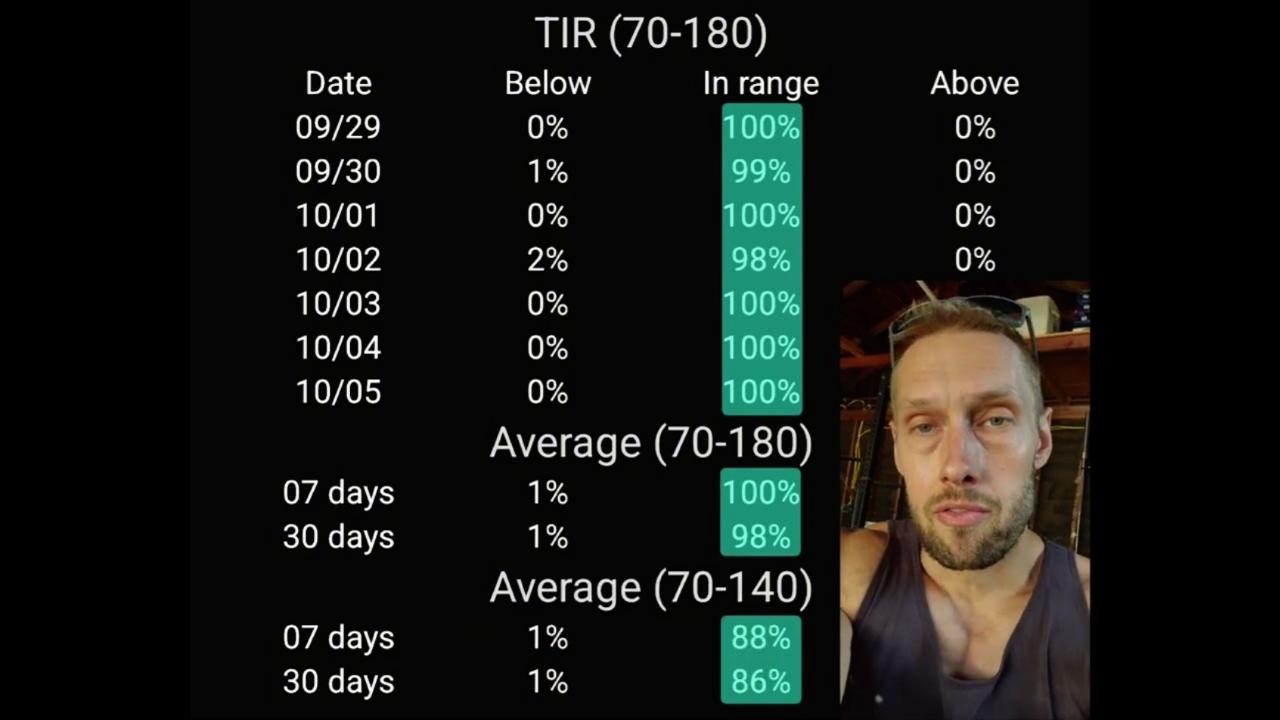
    Andrew's CGM time-in-range report, last 30 days
    My time-in-range report, last 30 days, on my own CGM.

    98% time in range over my last 30 days, 70 to 180. 100% over the last 7 days, and 86% in the tight range, 70 to 140.

    My HbA1c has stayed around 5.5% for more than ten years, and I need 43% less insulin than I did before I changed the way I eat.

    Steady State is new, so I won't pretend to have a wall of client results. What I can show you is what happened when people watched my TEDx talk and tried it on their own.

    These are viewers, not clients, in their own words.

    "I was 53% on target … just 45 days atter … 91% on target."

    @tarcisosilva5503 · from the comments under my TEDx talk

    "Type 1 for 40 years … my HB1C has gone from 12 in the past now down to lowest EVER: 6,8."

    @PeaceLoveJoyWorld · from the comments under my TEDx talk

    "my insulin needs have gone down tremendously, both basal and bolus"

    @diabeticmuscle45 · from the comments under my TEDx talk

    "it changed my life better levels than ive had in 14 years"

    @jemaldernawi1539 · from the comments under my TEDx talk

    They did that on their own, without a coach or a plan built around their numbers.

    Steady State gives you the whole method, a coach reviewing your CGM every week, and a plan my team builds from your own numbers.

    Bring your last 14 days of CGM data to the call, and my team will show you where your own biggest swings are coming from.

    Andrew

  3. 08 "My endo won't agree" +34 hoursafter booking Why they wouldn't buy
    Andrew Koutnikteam@andrewkoutnik.com

    What to say to your endocrinologist

    PreviewYou're not going around your doctor. You're bringing them in.

    Hey {FIRST NAME},

    This is the worry I'd have in your seat, so let's deal with it before your call.

    "What if my endo won't agree with any of this?"

    They might not, at first. Most endocrinologists were trained on the same count-and-cover advice you were. Earlier this year I wrote that nutrition remains an afterthought in diabetes care, and that's how the system was built, not a failing of your doctor.

    So Steady State doesn't ask you to go around them. It gives you a better conversation to have with them.

    Your Steady State Plan includes a one-page Endo Brief. It's short enough to read in the appointment, and it lays out the research behind the method, including the first international guidelines on carbohydrate reduction in type 1, which I co-wrote.

    It also includes a dosing worksheet built from your own CGM data. You're not walking in with "I read something online". You're walking in with your own graphs, the pattern in them, and a specific question.

    Endos see a lot of patients with a lot of ideas. What gets their attention is data.

    Your coach helps you get ready for that appointment, so you know what to bring and what to ask.

    And if your endo still says no to a change, you don't make it. Everything in Steady State happens alongside your care team.

    On the call, tell my team how your last few appointments have gone. It helps them see what you'll need.

    Andrew

    P.S. One viewer under my TEDx talk wrote, "Finally something i can use to back up my arguements with my endo". That's the job the Endo Brief does.

  4. 09 "Is it safe?" +44 hoursafter booking Why they wouldn't buy
    Andrew Koutnikteam@andrewkoutnik.com

    Is it safe to lower my insulin?

    PreviewThe honest answer, and the one rule nobody in Steady State breaks.

    Hey {FIRST NAME},

    You should ask this about anything that touches your insulin, so I'm glad if you're asking it.

    Here's the honest answer.

    When you lower the load, your insulin needs can drop, and they can drop fast. Mine dropped by 43% after I changed the way I eat.

    That's what you want to happen, and it's also where the risk is. If you shrink your meals and keep dosing the way you used to, you'll go low.

    So nobody in Steady State changes a dose on their own. Every dosing change happens alongside your care team. That's the one rule.

    The rest of the program is built around it.

    You change one thing at a time, starting with one meal, so it's always clear what caused what.

    Your coach, a certified diabetes educator, reviews your CGM data every week, so a pattern of lows gets spotted early instead of three months later at your next appointment.

    Your dosing worksheet is something you take to your care team, not something you follow on your own.

    And Steady State doesn't replace your insulin, your pump or your doctor. You keep all three. What changes is what you're dosing for.

    If there's anything else going on with your health, tell my team on the call, and they'll be straight with you about whether now's the right time.

    See you on [CALL TIME].

    Andrew

03Day three

Hours 48 to the call · 5 emails

  1. 10 The first 14 days +50 hoursafter booking Why they'd buy
    Andrew Koutnikteam@andrewkoutnik.com

    Your first 14 days

    PreviewWhat actually happens after you say yes.

    Hey {FIRST NAME},

    I want you to know exactly what the start looks like, so nothing about it catches you off guard.

    Days 1 to 14. You start the first lessons on the Low-Load plate and keep wearing your CGM. Those first 14 days of data are what my team builds your plan from.

    Around day 14. My team builds your Steady State Plan: your starting meal map, a dosing worksheet to take to your care team, and your one-page Endo Brief.

    Weeks 3 and 4. You rebuild meals from your meal map, one at a time, and go over your dosing worksheet with your care team.

    Every week, from week one. Your coach looks at your CGM data, and you can join my live call.

    So what do you look for early on?

    The first thing we watch is the shape of the line after the meals you've rebuilt: smaller rises and flatter afternoons, and, as your care team adjusts your doses, your total daily insulin starting to come down.

    Weeks 5 to 8 go after the late climbs and the nights. Weeks 9 to 12 bring in training, sick days and travel.

    I won't tell you exactly where your time in range lands by week 12, because everyone starts from a different place. That's what the guarantee is for, and I'll walk you through it before your call.

    On the call, ask my team how the first two weeks would look for you specifically.

    Andrew

  2. 11 "I don't have time" +58 hoursafter booking Why they wouldn't buy
    Andrew Koutnikteam@andrewkoutnik.com

    How much time this really takes

    PreviewLess than type 1 is already taking from you.

    Hey {FIRST NAME},

    If you're worried you don't have time for a 12-week program, here's what a week actually asks of you.

    One short lesson, then one action for the week. Usually that's one meal to rebuild or one thing to try with your timing.

    One 90-minute call, live or recorded. Listening while you cook works fine.

    Your CGM, which you're already wearing. Your coach reviews it every week and answers your questions in between.

    No meal-prep Sundays, no special foods, no two-hour gym sessions.

    Now think about how much time type 1 already takes from you. Every correction. Every time you stop what you're doing to deal with a low. Every 3 AM alarm, and the tired day that follows it. Every workout you cut short.

    Most of that time goes on big swings. Smaller inputs mean smaller swings, so the time you put into Steady State each week buys back time you're already losing.

    If your calendar's packed right now, tell my team on the call. They'll be honest with you about whether this is the right time to start.

    Andrew

  3. 12 Guarantee + expectations +64 hoursafter booking Decision
    Andrew Koutnikteam@andrewkoutnik.com

    What happens if your numbers don't move

    PreviewWhat this takes, and my guarantee if you do the work.

    Hey {FIRST NAME},

    Before you talk to my team, I want to be straight with you about two things.

    First, what this takes.

    Steady State is simple, but it isn't passive. You wear your CGM. You follow the plan my team builds for you. You show up to the weekly call or watch it after. And you make your dosing changes with your care team, which means actually booking that appointment.

    If you're hoping for a supplement or a hack, this isn't that.

    Second, what happens if you do the work and nothing moves.

    Here's my guarantee. Do the work for 12 weeks (wear your CGM, follow the plan, show up or watch the weekly call) and if your time in range hasn't improved, we keep coaching you free until it has.

    I can offer that because I know what happens to a CGM line when the inputs get small. I see it on my own every day.

    One more thing. Each cohort is capped at 40 people, because a coach reviews every member's data every week. So on the call, my team will be honest with you about whether it's a fit and whether there's still a spot.

    Come with your questions, and come with your graph.

    Andrew

    P.S. Your call is [CALL TIME]. If you need to move it, please do it here rather than missing it, so the slot can go to someone else: [CALENDAR LINK]

  4. 13 Day of the call +70 hoursthe day of the call Show-up
    Andrew Koutnikteam@andrewkoutnik.com

    Today's the day

    PreviewYour call with my team is at [CALL TIME].

    Hey {FIRST NAME},

    Your call with my team is today, [CALL TIME].

    Before you join, pull up your last 14 days of CGM data and have a rough idea of your daily insulin.

    Find somewhere quiet where you can talk openly about your numbers.

    And bring the question you've been carrying around since the masterclass. That's the one to ask first.

    Your call details are here: [CALENDAR LINK]

    Andrew

  5. 14 Ten minutes 10 min beforethe call Show-up
    Andrew Koutnikteam@andrewkoutnik.com

    Starting in 10 minutes

    PreviewHave your CGM app open.

    Hey {FIRST NAME},

    Your call with my team starts in 10 minutes. Have your CGM app open and somewhere quiet to sit.

    The link to join is in your calendar invite, and here: [CALENDAR LINK]

    Andrew