Email sequence

The pre-webinar sequence

01Right after they register

Timed from sign-up · 6 emails

  1. 01 Confirmation Immediatelyafter they register Q4 · Expectations
    Andrew Koutnikteam@andrewkoutnik.com

    You're in for Tuesday. Reply YES so my emails reach you

    PreviewTuesday, November 10 at 7 PM ET. Two quick things before then.

    Hey {FIRST NAME},

    You're in for The Steady State Masterclass.

    Tuesday, November 10, at 7 PM Eastern (4 PM Pacific). It runs about 90 minutes, and I'm staying on at the end for your questions.

    Two quick things so you don't miss it.

    First, hit reply and type YES. That tells your inbox my emails belong in your main tab, which is where Tuesday's join link needs to land.

    Second, put it in your calendar now, while it's on your mind. The invite has your join link inside it: [CALENDAR LINK]

    Here's what I'll walk you through live:

    1. 01How to build Low-Load meals that need far less insulin.
    2. 02How to dose for protein and fat so the late climbs stop.
    3. 03The pre-workout protocol that lets you train hard without going low.

    It's the method I use to keep my own blood sugar in range 98% of the day, and I'll have my own CGM data on screen while I teach it.

    Talk soon,

    Andrew
  2. 02 Your gift + the group +10 minafter they register Show-up
    Andrew Koutnikteam@andrewkoutnik.com

    Your Low-Load Swap Sheet is in the group

    PreviewThirty everyday meals, rebuilt so they need far less insulin.

    Hey {FIRST NAME},

    I promised you a gift for saving your seat.

    It's called The Low-Load Swap Sheet. Thirty everyday meals, rebuilt so they need far less insulin.

    It's the breakfasts, lunches, dinners and restaurant orders I actually eat, each one with the swap.

    I'm not sending it by email. It's pinned in the WhatsApp group for Tuesday's class, next to the join link and a few things I'll share before we go live.

    Join here and it's the first thing you'll see: [WHATSAPP LINK]

    Then pick one meal off the sheet this week and eat it with your CGM on.

    Watch the line for the three hours after, and compare it to what your usual version of that meal does to you.

    Do that once and a lot of Tuesday will already make sense.

    Andrew

    P.S. In my next email I'll give you the idea the whole sheet is built on. It's four words long.

  3. 03 The method +25 minafter they register Q1 · First-layer question
    Andrew Koutnikteam@andrewkoutnik.com

    Smaller inputs, smaller mistakes

    PreviewThe four words behind every meal on the Swap Sheet.

    Hey {FIRST NAME},

    So, the method I'm teaching on Tuesday has a name. I call it the Low-Load Method.

    It comes down to four words: smaller inputs, smaller mistakes.

    Every dose of insulin you take is an educated guess. Your carb count is an estimate, your absorption changes with stress and sleep, and the same dose never hits exactly the same way twice.

    So every dose carries some error. Now think about how big that error is.

    Say you eat a bowl of pasta that needs 12 units, and on another night you eat a Low-Load plate that needs 3.

    If you're off by the same percentage both times, the miss on the pasta is four times bigger.

    On the pasta, that miss is the difference between a good evening and a spike you're chasing until bedtime. On the Low-Load plate, the same miss barely shows up on your graph.

    That isn't you failing at type 1. It's arithmetic.

    Big carb loads need big doses, and every big dose carries a big error that no pump can fully catch. Lower the load and the doses shrink, the errors shrink with them, and the line on your CGM starts to flatten.

    On Tuesday I'll show you how I build those plates, with my own CGM data on screen.

    If it's not in your calendar yet: [CALENDAR LINK]

    Andrew

  4. 04 The insulin math +45 minafter they register Q2 · Second-layer question
    Andrew Koutnikteam@andrewkoutnik.com

    What happened when I needed 43% less insulin

    PreviewSteadier numbers were only half of it.

    Hey {FIRST NAME},

    More than ten years ago I changed the way I eat.

    Almost immediately my blood sugar settled down, and I needed less insulin. 43% less.

    Most people hear that and think about steadier numbers. That's part of it.

    But I want you to understand what the total amount of insulin does on its own, even when your A1c looks fine on paper.

    We know that when you carry more insulin than you need, day after day, your body starts responding to it less. That's insulin resistance.

    So the same meal takes a bit more insulin, which feeds a bit more resistance, and around it goes.

    I call it double diabetes: type 1, with type 2 style insulin resistance stacked on top.

    You won't hear that term at most appointments, because the standard advice is about covering the food, not about how much insulin you're carrying.

    Lowering the load works on both at once. Smaller inputs mean smaller doses and smaller mistakes, and smaller doses mean less insulin pushing you toward double diabetes.

    On Tuesday I'll show you what that looked like in my own numbers.

    Andrew

    P.S. Next, how I ended up studying this for a living. It started in a hospital bed when I was 16.

  5. 05 Founder story +75 minafter they register Q4 · Expectations
    Andrew Koutnikteam@andrewkoutnik.com

    i was 16, in a hospital bed

    PreviewAnd the plan they sent me home with is probably the one you got too.

    Hey {FIRST NAME},

    I was 16 when I ended up in a hospital bed and heard three words that changed my life: type 1 diabetes.

    The plan they sent me home with is probably the one you got. Count carbs, take insulin, and hope the numbers balance out.

    I was a heavy teenager as well, and I did everything I was told about that too. I exercised constantly, ate what my doctor and the fitness magazines said to eat, and kept gaining anyway.

    More than ten years ago I tried something different and cut way down on the carbs on my plate.

    Almost immediately my numbers settled, and I needed 43% less insulin.

    My physician at the time told me he'd never seen a normal blood sugar in a patient with type 1.

    That stuck with me, and it's a big part of why I've spent my career studying this. I've worked with NASA, Johns Hopkins and the Department of Defense, published over 100 peer-reviewed papers and abstracts, and co-written the first international guidelines on carbohydrate reduction in type 1. My own case is in the scientific literature now.

    My HbA1c has stayed around 5.5% for more than ten years, and my last 30 days on my own CGM read 98% time in range.

    I'm not telling you this to show off. I'm telling you because I know what it's like to do everything you're told and still watch it not work.

    It was never my discipline. It was the size of the inputs.

    On Tuesday I'll show you exactly what I changed, and how you'd do it alongside your own care team.

    Andrew

  6. 06 What it takes +195 minabout 3 hours after they register Q3 · Objection
    Andrew Koutnikteam@andrewkoutnik.com

    Do I have to eat like you forever?

    PreviewThe honest answer, and what this actually takes.

    Hey {FIRST NAME},

    After people hear my story, the next question is usually some version of this one.

    "Andrew, do I have to eat the way you eat?"

    No, you don't.

    I eat very low carb because it works for me and I've done it for more than ten years. You don't have to match me.

    The Low-Load Method isn't a diet with a number you have to hit. It's about bringing the load down to a level that fits your life, your training and your care team.

    Here's what it actually takes.

    You keep wearing your CGM, and you change one meal at a time while you watch what the line does.

    You learn to dose for protein and fat, so a lower-carb dinner doesn't climb on you at 10 PM.

    And you make any dosing change with your care team, never on your own.

    You don't need special foods or a whole Sunday of meal prep.

    On Tuesday I'm not going to tell you to give up pizza for life. I'm going to show you why the size of what's on your plate matters more than any single food, and how to make it smaller without feeling like you're missing out.

    Andrew

    P.S. Next: the advice most of us got at diagnosis, and why it's built around the doses instead of around you.

02The run-up

Sat, Nov 7 to Mon, Nov 9 · 10 emails

  1. 07 The villain Sat, Nov 79:00 AM ET Q1 · First-layer question
    Andrew Koutnikteam@andrewkoutnik.com

    "Eat whatever you want, just cover it with insulin"

    PreviewThe advice most of us got at diagnosis, and what it costs.

    Hey {FIRST NAME},

    If you've lived with type 1 for a while, you've probably heard some version of this.

    "You can eat whatever you want. Just cover it with insulin."

    It sounds kind, and on paper it works, because a big enough dose can cover almost anything.

    Here's what it looks like in real life.

    Pasta for dinner. You count, you dose, you wait.

    At 9 PM you're at 240 and climbing, so you correct.

    At 1 AM your CGM is going off and you're standing in the kitchen with a juice box, half asleep, trying to remember how much you took.

    Three months later your endo looks at your A1c, says it's not bad, and tells you to keep doing what you're doing.

    You did exactly what you were told. Count carbs, take insulin, and hope the numbers balance out. The trouble is that the advice is built around the doses, not around you.

    One comment under my TEDx talk says it better than I can:

    "never been advised by any medical professional that actual nutrition is important"

    @amymadden4631 · from the comments under my TEDx talk

    That's from someone who's lived with type 1 for more than 30 years. Nobody told me either, for a long time.

    On Tuesday I'll show you the other way: smaller inputs, so you're not chasing your numbers all day.

    Andrew

    P.S. In a few hours: why so many of us go low halfway through a workout, even after eating for it.

  2. 08 The gym low Sat, Nov 71:00 PM ET Q2 · Second-layer question
    Andrew Koutnikteam@andrewkoutnik.com

    Why you go low halfway through a workout

    PreviewIt usually has more to do with lunch than with the workout.

    Hey {FIRST NAME},

    If you train, you'll know this one.

    You have lunch, you dose for it, and a couple of hours later you head out for a run or to the gym.

    Twenty minutes in, your CGM starts buzzing. So you stop, eat something sweet, wait for the number to come back up, and by then the session's gone.

    Or you go the other way. You eat a snack beforehand just in case, finish the workout fine, and spend the evening correcting the high.

    A lot of people with type 1 decide exercise and good numbers don't go together, and some quietly stop training.

    Here's what's usually going on.

    When you move, your muscles pull sugar out of your blood, and they need far less insulin to do it.

    If there's still a big dose from lunch working in your body, the two stack on top of each other, and you drop.

    So the bigger the meal before, the bigger the dose still on board, and the faster you fall.

    It's the same idea as everything else I teach. Smaller inputs, smaller mistakes.

    The third thing I'm covering on Tuesday is the pre-workout protocol that lets you train hard without going low. It's built from my work with elite athletes, NHL players and special forces among them, scaled down to a normal week.

    You don't need to be an athlete for it. It's for anyone who's tired of finishing a workout with a juice box in their hand.

    And like any change to your dosing, you'd set it up with your care team.

    Andrew

    P.S. Tonight I'm sending you my last 30 days of CGM data. The actual report, not a summary.

  3. 09 Proof: my own CGM Sat, Nov 76:00 PM ET Q4 · Expectations
    Andrew Koutnikteam@andrewkoutnik.com

    My last 30 days, straight off my CGM

    Preview98% in range. Here's the report.

    Hey {FIRST NAME},

    I said I'd send you the actual report, not a summary of it.

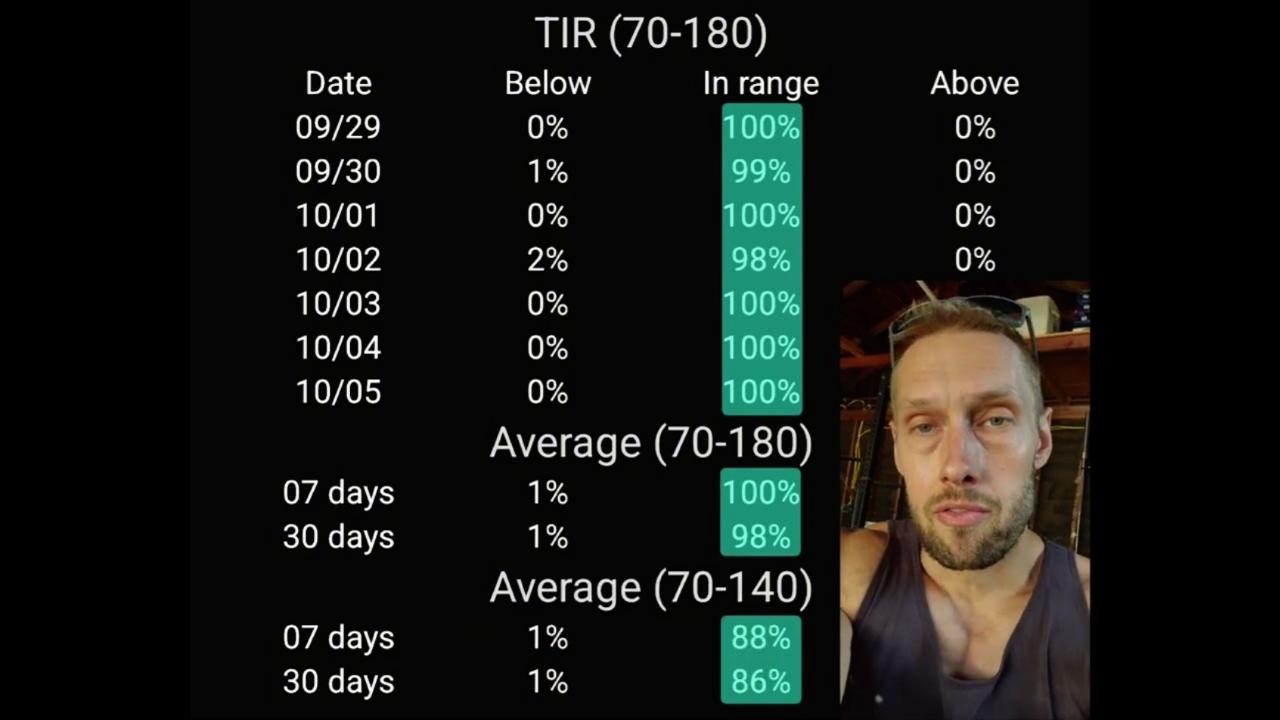
    Andrew's CGM time-in-range report, last 30 days
    My time-in-range report, last 30 days, on my own CGM.

    98% time in range over the last 30 days. That's 70 to 180 mg/dL.

    100% over the last 7 days.

    And 86% in the tight range, 70 to 140.

    It isn't one good month, either. My HbA1c has stayed around 5.5% for more than ten years.

    I want you to see that a flat line with type 1 isn't a fantasy someone's selling you. It's what happens when the inputs get small.

    I don't have a special pancreas, and I'm not more disciplined than you. I still take insulin every day, and my doses still aren't perfect.

    The difference is that a wrong dose on a small meal is a small miss, so my line wobbles a little instead of taking off.

    On Tuesday I'll put this report on screen and walk you through what a normal day of eating looks like behind it.

    Andrew

    P.S. You don't need 98%. Think about what a few more hours in range every day would do to an ordinary week.

  4. 10 Why low carb failed Sun, Nov 89:00 AM ET Q2 · Second-layer question
    Andrew Koutnikteam@andrewkoutnik.com

    "I tried low carb and my numbers got worse"

    PreviewYou weren't wrong about the carbs. You were missing one piece.

    Hey {FIRST NAME},

    I hear this one more than almost anything else.

    "Andrew, I tried low carb. My numbers got worse."

    If that's you, I believe you, and I don't think you did anything wrong.

    Here's what usually happens. You cut the carbs, your mealtime doses get smaller, and for the first couple of hours after dinner the line looks great.

    Then around three hours later you start to climb. It's a slow, stubborn rise that a correction never quite catches, and some nights it runs all the way to morning.

    So you decide low carb doesn't work for your body. Anyone would.

    But it wasn't the low carb. You cut the carbs and kept dosing like a carb counter.

    Protein and fat raise your blood sugar too, just later and slower. If you dose a steak dinner the way you'd dose a slice of toast, your insulin has finished working by the time the protein and fat show up.

    That late climb has a cause, and the fix is mostly timing.

    It's the second thing I'm teaching on Tuesday: how to dose for protein and fat so the late climbs stop. You'll see why your number rises three hours after dinner, and the timing that fixes it.

    As with everything I teach, you'd make those changes alongside your care team.

    If you want a head start, try one of the dinners on the Swap Sheet this weekend. It's pinned in the group: [WHATSAPP LINK]

    Andrew

  5. 11 Objection FAQ Sun, Nov 82:00 PM ET Q3 · Objection
    Andrew Koutnikteam@andrewkoutnik.com

    Let me guess what you're thinking, {FIRST NAME}

    PreviewMy endo won't go for it. Is it safe? I've had type 1 for decades.

    Hey {FIRST NAME},

    Before Tuesday, I want to answer the questions I'd be asking if I were in your seat.

    "My endo won't go for this."

    Maybe not at first. A lot of endocrinologists were trained on the same cover-it-with-insulin advice you were.

    That's why, at the end of the live class, I'm giving everyone The Endo Conversation Kit: a one-page summary, the research behind it, and the questions to ask at your next appointment. The goal is to get your endo on your side, not to go around them.

    One viewer put it better than I could:

    "Finally something i can use to back up my arguements with my endo"

    @markbuckle831 · from the comments under my TEDx talk

    "Is this safe?"

    When you lower the load, your insulin needs can change quickly. Mine dropped by 43%. That's exactly why you never change a dose on your own. You do this alongside your care team.

    "I've had type 1 for decades. Isn't it a bit late?"

    "Type 1 for 40 years … my HB1C has gone from 12 in the past now down to lowest EVER: 6,8."

    @PeaceLoveJoyWorld · from the comments under my TEDx talk

    That's a viewer, not a client, and they worked it out on their own. The arithmetic doesn't care how long you've had it. A smaller dose carries a smaller error in year 2 and in year 40.

    "I don't have time to cook special meals."

    You won't need to. Most of the Swap Sheet is ordinary food with one thing changed, and that includes the restaurant orders.

    "Are you going to sell me something?"

    At the end, I'll tell you how you can work with me and my team if you'd like help putting this in place. It's optional, and you keep everything I teach before that either way.

    See you Tuesday at 7 PM ET. If it's not in your calendar yet: [CALENDAR LINK]

    Andrew

  6. 12 Future pace Sun, Nov 87:00 PM ET Q4 · Expectations
    Andrew Koutnikteam@andrewkoutnik.com

    A Wednesday with nothing to correct

    PreviewWhat a flat line feels like from the inside.

    Hey {FIRST NAME},

    I want you to picture an ordinary Wednesday, not a perfect one.

    You wake up and check your phone. The overnight line is flat, with no 3 AM alarm and no juice box on the nightstand.

    Breakfast is eggs and something green. You take a small dose, and two hours later the line has barely moved.

    Lunch is a big salad with chicken at your desk, and you spend the 2 PM meeting listening to the meeting instead of watching an arrow point up.

    After work you go for a run without eating your way through the last mile to stay out of a low.

    Dinner is steak and vegetables. Three hours later, right when your number would usually start creeping up, it doesn't.

    At 10 PM you look at your CGM and realise you haven't corrected once all day.

    That's what stability feels like. It's quiet, and honestly a bit boring.

    I can't promise you that day by next week. Everyone starts somewhere different, and every change happens alongside your care team.

    But it's a real day, and I've had a lot of them.

    On Tuesday I'll show you the three pieces that build it.

    Andrew

  7. 13 Pumps and big meals Mon, Nov 98:00 AM ET Q2 · Second-layer question
    Andrew Koutnikteam@andrewkoutnik.com

    Why your pump can't fully catch a big meal

    PreviewEven the best algorithm reacts to a rise that's already started.

    Hey {FIRST NAME},

    If you're on an automated pump, you might be thinking this doesn't apply to you.

    "Isn't my pump supposed to handle all this?"

    Automated pumps are a real step forward. But think about what the algorithm is actually doing.

    It watches your CGM. When it sees you rising, it adds insulin, and when it sees you dropping, it pulls back. It works a bit like a thermostat.

    So it's always responding to a change that's already happening.

    A big plate of fast carbs is like a small hose turned all the way on. Glucose arrives quickly, and even fast insulin takes a while to get going.

    By the time the algorithm sees the rise and responds, you're already high. Then the extra insulin lands, and two hours later you're heading down.

    With a Low-Load plate the rise is small and slow, so the algorithm has time to keep up. Your pump suddenly looks a lot smarter than it did.

    That's why some of the people with the best tech still ride the rollercoaster. It was never the pump settings. It was the size of the inputs.

    Tomorrow night I'll show you how to build those plates.

    Andrew

  8. 14 Why free Mon, Nov 912:00 PM ET Q3 · Objection
    Andrew Koutnikteam@andrewkoutnik.com

    Why I'm teaching this for free

    PreviewMost of what I know is stuck in journals patients never read.

    Hey {FIRST NAME},

    You might be wondering why I'm doing this for free.

    I've spent my career on this question. Over 100 peer-reviewed publications and abstracts, and over $70 million in research funding from places like the NIH, the Department of Defense and DARPA. I co-wrote the first international guidelines on carbohydrate reduction in type 1, and my own case is in the scientific literature.

    And almost none of it reaches the person sitting in an endo's office being told to cover their pasta with insulin.

    Earlier this year I wrote that nutrition remains an afterthought in diabetes care. I still think that's true, and you can see it in the comments under my TEDx talk: people who've lived with type 1 for decades, writing that nobody ever told them food mattered.

    I'm patient first. I live with this too, so I know what a 3 AM low feels like.

    My goal for anyone with type 1 is zero days of lost life to it. A free live class is the fastest way I know to get this in front of the people who need it.

    And yes, at the end I'll tell you how you can work with me and my team if you want help putting it in place. You'll get plenty out of the night without it.

    See you tomorrow.

    Andrew

  9. 15 Sneak peek Mon, Nov 94:00 PM ET Q4 · Expectations
    Andrew Koutnikteam@andrewkoutnik.com

    What we're covering tomorrow night

    PreviewThree pieces, and one of them nobody taught you.

    Hey {FIRST NAME},

    Tomorrow at 7 PM ET we go live. Here's what I'll walk you through.

    01 · The Low-Load plate. How to build Low-Load meals that need far less insulin. Smaller inputs mean smaller doses, and smaller doses mean smaller mistakes.

    02 · Dosing for real food. How to dose for protein and fat so the late climbs stop. Why your number rises three hours after dinner, and the timing that fixes it. This is the piece most of us were never taught, and it's why low carb "didn't work" for so many people.

    03 · Training without the crash. The pre-workout protocol that lets you train hard without going low. Built from my work with elite athletes, scaled to a normal week. You don't need to be an athlete for this one. It's for anyone who's tired of eating their way out of a low at the gym.

    Then I'll take your questions for as long as I can.

    At the very end I'm handing out The Endo Conversation Kit: a one-page summary, the research behind it, and the questions to ask at your next appointment. So stay to the end.

    Save this link. It's the one you'll use to join: [JOIN LINK]

    Andrew

  10. 16 Day-before prep Mon, Nov 97:00 PM ET Show-up
    Andrew Koutnikteam@andrewkoutnik.com

    Three things to have ready tomorrow

    PreviewTen minutes of prep and you'll get far more out of the night.

    Hey {FIRST NAME},

    24 hours from now we're live, and you'll get a lot more out of it with three things in front of you.

    Your last 14 days of CGM data. The report in your Dexcom or Libre app is perfect. You'll want your own graph open while I'm explaining mine.

    One meal that always wrecks you. The one you've given up trying to dose for. Write it down and keep it in mind when we get to the Low-Load plate.

    Something to write on. There's a lot of timing detail in the protein and fat section, and you'll want it later.

    Here's your link for tomorrow at 7 PM ET: [JOIN LINK]

    Andrew

    P.S. If you haven't joined the WhatsApp group yet, the Swap Sheet is still pinned at the top.

03Show day

Tue, Nov 10 · 7 emails

  1. 17 Morning of Tue, Nov 108:00 AM ET Q3 · Objection
    Andrew Koutnikteam@andrewkoutnik.com

    I already know what you woke up thinking

    Preview"I'll just catch the replay." Here's why I'd come live.

    Hey {FIRST NAME},

    We're live tonight at 7.

    And if you're anything like me, part of you woke up thinking you'll just catch the replay.

    I get it. It's a weeknight, you're tired, and your CGM will probably beep at you at least once before 7.

    But the Q&A only happens live. That's where I answer questions about your numbers, your pump and your endo, and you can't ask a replay anything.

    And stay to the end, because that's when I hand out The Endo Conversation Kit.

    7 PM ET, 4 PM PT. Here's your link: [JOIN LINK]

    Andrew

  2. 18 Viewer proof Tue, Nov 103:00 PM ET Q4 · Expectations
    Andrew Koutnikteam@andrewkoutnik.com

    From 53% to 91% in 45 days

    PreviewViewers, not clients. Here's what three of them wrote.

    Hey {FIRST NAME},

    We're live in four hours. While you wait, I want to show you something, and I want to be careful about it.

    These aren't clients. They're viewers: people who watched my TEDx talk and went off and tried it on their own.

    "I was 53% on target … just 45 days atter … 91% on target."

    @tarcisosilva5503 · from the comments under my TEDx talk

    "my insulin needs have gone down tremendously, both basal and bolus"

    @diabeticmuscle45 · from the comments under my TEDx talk

    "it changed my life better levels than ive had in 14 years"

    @jemaldernawi1539 · from the comments under my TEDx talk

    Tonight you get the whole method, step by step, with my own data on screen and time for your questions.

    7 PM ET: [JOIN LINK]

    Andrew

  3. 19 Two hours Tue, Nov 105:00 PM ET Q3 · Objection
    Andrew Koutnikteam@andrewkoutnik.com

    You don't need a science degree for tonight

    PreviewTwo hours to go, and a word on how I teach.

    Hey {FIRST NAME},

    We're live in two hours.

    If you're picturing a lecture full of jargon because a scientist is running it, I understand why. It won't be one.

    I'll explain everything the way I'd explain it to a friend over dinner. When I put a graph up, I'll walk you through what you're looking at before I tell you what it means.

    If you can read your own CGM app, you'll follow every minute of it.

    7 PM ET: [JOIN LINK]

    Andrew

  4. 20 One hour Tue, Nov 106:00 PM ET Q1 · First-layer question
    Andrew Koutnikteam@andrewkoutnik.com

    One hour

    PreviewGrab your CGM report and a glass of water.

    Hey {FIRST NAME},

    We go live in one hour.

    If you've spent years doing everything you were told and still chasing your numbers, tonight is the 90 minutes that explains why.

    It was never your discipline, your pump settings or your endo. It was the size of the inputs, and I'm going to show you how to change them.

    Join here at 7 PM ET: [JOIN LINK]

    Andrew

  5. 21 Doors open Tue, Nov 106:50 PM ET Show-up
    Andrew Koutnikteam@andrewkoutnik.com

    The room's open

    PreviewCome say hi before we start.

    Hey {FIRST NAME},

    I've just opened the room.

    Come in now, grab your seat and say hi in the chat. Tell me how long you've lived with type 1, and I'll read some of them out before we start.

    We begin at 7 on the dot: [JOIN LINK]

    Andrew

  6. 22 Live now Tue, Nov 107:00 PM ET Show-up
    Andrew Koutnikteam@andrewkoutnik.com

    We're live

    PreviewStarting with the Low-Load plate.

    Hey {FIRST NAME},

    The Steady State Masterclass is live right now.

    I'm opening with the Low-Load plate, the piece that makes everything else easier.

    Come straight in: [JOIN LINK]

    Andrew

  7. 23 Recovery Tue, Nov 107:15 PM ET Show-up
    Andrew Koutnikteam@andrewkoutnik.com

    You haven't missed the important part

    PreviewWe're still on the first piece.

    Hey {FIRST NAME},

    We started 15 minutes ago and we're still on the Low-Load plate, so you haven't missed anything you can't catch up on.

    The protein and fat section, the one that explains the late climbs, is still ahead. So are the Q&A and The Endo Conversation Kit at the end.

    Come in now: [JOIN LINK]

    Andrew

04The WhatsApp group

Where the Swap Sheet lives · 10 messages